[es] comunicado no. 38 – Frente Nacional de Resistencia contra el Golpe de Estado

November 29, 2009 by akwesasnecounterspin

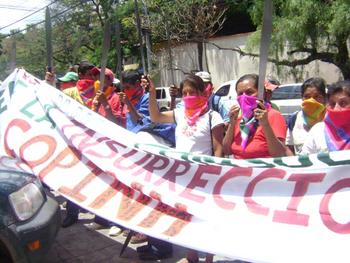
COMUNICADO No. 38. Frente Nacional de Resistencia contra el Golpe de Estado

Al pueblo hondureño y la comunidad internacional:

1. Denunciamos que horas antes de la farsa electoral de la dictadura militar, sus cuerpos represivos han emprendido una feroz persecución contra organizaciones populares que se han manifestado opuestas al Golpe de Estado.

Ejemplos de ello son el allanamiento y destrozo de la sede de la Red Comal en Siguatepeque; el cerco militar y el amedrentamiento con armas de fuego contra la sede del STIBYS en Tegucigalpa; el cerco militar contra la comunidad Guadalupe Carney en Silín, Colón, y contra la Colonia La Paz, en La Lima, Cortés; y la militarización del centro INESCO del padre Fausto Milla en Copán. De igual manera, nos llama a preocupación el atentado que sufrió el Centro de Derechos de Mujeres de San Pedro Sula, con una bomba.

Asimismo, la acción represiva ha recaído sobre miembros(as) activos(as) de la Resistencia Popular en la víspera de las votaciones, como sucede con la persecución que se ha desatado contra dirigentes de la Resistencia en la Colonia Kennedy y El Reparto, de Tegucigalpa; en Gualala, Santa Barbara; en San Pedro Sula, Cortés; y la captura de la dirigente feminista Merlyn Eguigure, en Tegucigalpa, liberada tras la presión hecha por sus compañeras del Movimiento Visitación Padilla.

También han sido allanados el centro de trabajo del dirigente del Partido Unificación Democrática, Gregorio Baca, de donde se llevaron detenido a su vigilante Humberto Castillo (discapacitado), y el allanamiento de la casa de la hermana de la periodista Percy Durón, de Radio América. Para rematar, el señor Fabricio Salgado Hernández, de la colonia Tiloarque, está en estado crítico tras ser baleado por militares que custodian el Edificio del Estado Mayor, pues el herido tuvo un accidente por los obstáculos que los militares han colocado.

2. Esta violencia muestra el estado de indefensión en que se encuentra el Pueblo Hondureño ante las huestes represivas del gobierno de facto. Retrata también el clima de persecución en que se realiza el circo electoral que inicia el día de hoy. Por ello, el Frente Nacional de Resistencia contra el Golpe de Estado reitera que no existen condiciones para la realización de elecciones limpias y seguras, y que el empecinamiento de este desgobierno en realizarlas solo obedece a su urgencia “lavarle” la cara al relevo de golpistas que surgirá de las mismas.

3. Alertamos al Pueblo Hondureño y a la comunidad internacional, sobre la eventualidad de que esta escalada represiva se incremente en las próximas horas teniendo como marco justificativo la ola de atentados que en forma sospechosa se realizan contra buses, escuelas y edificios públicos, cuya autoría la Policía Nacional atribuye en forma casi automática, irresponsable y tendenciosa a la Resistencia Popular.

4. Por tal motivo el Frente Nacional de Resistencia contra el Golpe de Estado reiteramos que nuestra lucha es PACIFICA y ratificamos nuestro llamado al Pueblo Hondureño para que no participe de la farsa electoral montada por la oligarquía el dia de hoy. A la vez que desmentimos cualquier mensaje con el cual se pretenda crear confusión, diciéndole al Pueblo que la Resistencia llama a votar.

¡RESISTIMOS Y VENCEREMOS!

Dado en la ciudad de Tegucigalpa, M.D.C. 28 de noviembre de 2009

[es] COFADEH: Militares y policias allanan instalaciones de Red COMAL

November 28, 2009 by akwesasnecounterspin

El Comité de Familiares de Detenidos Desaparecidos en Honduras, COFADEH, denuncia ante la comunidad nacional e internacional, que las instalaciones de la Red Comal , con sede en Siguatepeque han sido ilegalmente  allanadas por militares y policías que han procedido a registrar todo cuanto encuentran a su paso y han dañado algunas puertas de la organización.

El Cofadeh condena estas acciones represivas que apuntan al allanamiento de las organizaciones que condenan el golpe de Estado y sus consecuencias con la ruptura del orden constitucional.

De acuerdo a la versión del Comisario de Policía Lagos Sánchez, está llevando a cabo una orden de allanamiento emitida por el Juzgado de Letras Seccional de Siguatepeque, por acciones del Ministerio Público que conllevan el objetivo de búsqueda de armas, afiches y otros documentos que llaman a no votar este domingo 29 de noviembre, la cual fue presentada 15 minutos después del ingreso de militares y policías a las instalaciones de la Red Comal.

Esta acción es parte de la estrategia de los golpistas de sembrar el miedo en la población y deslegitimar las acciones del pueblo hondureño y de las organizaciones sociales que hacen uso de su derecho a la defensa  de la institucionalidad.

El COFADEH se ha desplazado con una delegación internacional de Derechos Humanos al sector para salvaguardar la integridad de los compañeros de Red Comal.

A la comunidad internacional llamamos a que hagan todas las acciones que estén a su alcance para contener esta barbarie.

DE LOS HECHOS Y LOS HECHORES

NI OLVIDO NI PERDON

Comité de Familiares de Detenidos Desaparecidos en Honduras, COFADEH

Tegucigalpa M.D.C. 28 de noviembre de 2009

[es] Marvin Palacios: Canal 36 nuevamente victima de la dictadura

November 20, 2009 by akwesasnecounterspin


(Esdra Amado López propietario de Canal 36)


Canal 36 nuevamente victima de la dictadura

por Marvin Palacios, DefensoresEnLinea.com


El canal 36 ha sido nuevamente víctima de los ataques de la dictadura al experimentar la señal de televisión un deterioro progresivo hasta desaparecer totalmente del aire, de acuerdo a la denuncia expuesta por su propietario el periodista Esdras Amado López.

López denunció esta mañana a través de Radio Globo (otro medio de comunicación que ha sido blanco de los ataques a la libertad de expresión) que “canal 36 ha sido sacado completamente del aire mediante una interferencia a su transmisor principal ubicado aquí en la capital de la Republica”.
“Esta interferencia que ha sacado del aire completamente a canal 36 consiste en la instalación de un transmisor paralelo al transmisor de canal 36, desde ese transmisor paralelo han estado transmitiendo durante la mañana películas pornográficas, de vaqueros y lo que se le antoja a una mente perversa en este momento poner en el aire”, sostuvo López.
El periodista propietario de canal 36 y de Radio La Catracha añadió que la interrupción a la señal se suscitó mientras el periodista Javier Aguilera presentaba el noticiario matutino del canal de televisión a tempranas horas de esta mañana.
López dijo que la frecuencia de canal 36 está siendo utilizada por un transmisor pirata y desde ese transmisor están emitiendo películas pornográficas, cualquier tipo de programación con el propósito de sacar del aire las emisiones noticiosas de canal 36.
“Aquí hay un doble delito, además de interferir nuestra señal están tomando una señal de cable o de un satélite y tienen una película de una compañía que se llama Platinum, eso no somos nosotros y yo le voy a pedir a las compañías de cable que no quiten esa señal para que quede en evidencia que ya hemos detectado un potente transmisor que todavía la ubicación me la reservo”, explicó el reconocido periodista.
Agregó que “esto es un dictadura, esto es intolerancia, esto es un abuso a la libertad de expresión y realmente ya no hayamos qué hacer”, reclamó el propietario de canal 36.
La frecuencia de canal 36 está siendo utilizada por un transmisor pirata

A partir del golpe de Estado Canal 36, radio La Catracha, Radio Globo, Radio Uno, Radio Progreso, Canal 11, Diario Tiempo y emisoras comunitarias han experimentado hostigamientos, amenazas, atentados, suspensiones temporales de sus señales, militarización y decomiso de sus equipos de transmisión poir incluir en sus espacios noticiosos las actividades y posiciones políticas del Frente Nacional de resistencia contra el Golpe de Estado

Este ataque contra canal 36 se presenta en momentos cuando faltan 9 días para las elecciones fraudulentas del 29 de noviembre en donde  muchos candidatos a cargos de elección popular han presentado su renuncia ante el Tribunal Supremo Electoral (TSE), por considerar que no existen condiciones para realizar los comicios generales.
El presidente  de la República , Manuel Zelaya Rosales, depuesto mediante un golpe de Estado el pasado 28 de junio, expresó en un comunicado que la convocatoria a elecciones generales en un estado de facto, sin que previamente no haya sido restaurado el orden constitucional, son una aberración jurídica, una burla y un engaño al pueblo.
Al respecto el periodista Esdras Amado López denunció que el TSE ha venido desarrollando varias reuniones con directores de medios de comunicación y que como no se ha convocado a canal 36, Radio Globo y canal 11, “el propósito es sacar del aire a canal 36 durante o antes y durante el proceso de las elecciones, pero no creí que lo fueran a hacer tan temprano”.
“Yo quiero responsabilizar al gobierno de facto de Roberto Micheletti Baín y principalmente a la Comisión Nacional de Telecomunicaciones (CONATEL) cuyo presidente de facto es Miguel Angel Rodas, porque a Rodas le hemos estado diciendo de todo lo que hemos sido víctimas en este canal 36” , dijo López.
“A la fiscal de derechos humanos, Sandra Ponce que ha mostrado una actitud cómplice con estas violaciones y por último responsabilizamos al TSE porque maliciosamente ha estado manteniendo reuniones con medios de comunicación que no somos los independientes, para trazar las líneas de cómo habrá de cubrirse el proceso electoral, dejándonos afuera a nosotros y no sabemos con qué fines no nos convocan y nos tienen fuera de este esquema de pláticas con el TSE”, recalcó.
Añadió que “condenamos con firmeza esta agresión a la libertad de prensa en Honduras de la que estamos siendo víctima por parte de este gobierno de facto”.
El gobierno de facto mantiene vigente el decreto 124-2009, en cuyo artículo 2  faculta a CONATEL a revocar o cancelar el uso de títulos habilitantes (permisos y licencias) a los operadores de medios de radiodifusión sonora y de televisión que emitan mensajes que generen apología al odio nacional, la afectación de bienes jurídicos protegidos, así como también un régimen de anarquía social en contra del estado democrático llegando a atentar contra la paz social y derechos humanos.
El decreto 124-2009 fue aprobado el 5 de octubre de 2009 y para los expertos en libertad de expresión, está dedicado a aquellos medios que han brindado cobertura a las acciones de protesta en contra del golpe de estado.
[Articulo publicado originalmente en DefensoresEnLinea.com]

[es] comunicado no. 35 – Frente Nacional de Resistencia contra el Golpe de Estado en Honduras

November 20, 2009 by akwesasnecounterspin

Comunicado No. 35

El Frente Nacional de Resistencia contra el Golpe de Estado comunica:

  1. Alertamos a la comunidad internacional y a las organizaciones defensoras de los derechos humanos sobre la creciente represión y persecución del pueblo organizado. En ese sentido el Comité para la Defensa de los Derechos Humanos de Honduras (CODEH) emitió un informe en el que advierte de los preparativos por parte de las fuerzas represivas del Estado para ejecutar acciones de terror, haciéndose pasar por militantes de la Resistencia, y justificar de esta manera el asesinato masivo de personas vinculadas al Frente Nacional de Resistencia contra el Golpe de Estado.
  2. Denunciamos la movilización de fuerzas militares en todo el territorio nacional, con armamento y equipo de campaña, que sobrepasa cualquier preparativo anterior que se haya hecho para un proceso electoral.Los preparativos de las Fuerzas Armadas incluyen la contratación de mercenarios, dentro de los que se encuentra un fuerte contingente de reservistas y la adecuación de hospitales y clínicas para la atención médica de los militares y policías involucrados en los actos de violencia contra la población.
  3. Hacemos ver que la anunciada “ausencia” del dictador Micheletti del poder que se daría entre los días 25 de noviembre y 2 de diciembre, es solamente una maniobra para ocultar el papel totalitario del régimen de facto y las Fuerzas Armadas que han montado un proceso electoral ilegítimo, ilegal y fraudulento.
  4. Condenamos las amenazas y hostigamientos contra diferentes medios de comunicación que informan la verdad sobre la situación que vive nuestro país, y que hoy vivió un nuevo episodio con la interrupción de la señal de canal 36.
  5. Reiteramos que bajo este régimen golpista de represión y antidemocracia es imposible realizar elecciones libres.
  6. Llamamos a todos los Frentes de Resistencia a nivel nacional y a las organizaciones comprometidas y solidarias en el exterior a que incrementen las medidas de seguridad y se preparen para realizar las denuncias ante cualquier tipo de violación de los derechos humanos por parte de la Dictadura.

“POR LA ASAMBLEA NACIONAL CONSTITUYENTE, RESISTIMOS Y VENCEREMOS”


Tegucigalpa, M.D.C. 20 de noviembre de 2009

[en] MISF – Fear and Loathing in Honduras: Elections Under Repression

November 20, 2009 by akwesasnecounterspin

Fear and Loathing in Honduras: Elections Under Repression

May I Speak Freely Media
November 20, 2009

As Honduras’ Nov. 29 election day quickly approaches, the broader picture of whether the vote can truly be free and fair has so far escaped the attention of the U.S. government and much of the world’s mainstream press. While focusing on the terms of the Tegucigalpa-San José Accords, their compliance or lack thereof, and the seemingly two-dimensional Manuel Zelaya/Roberto Micheletti dispute over the country’s presidency, government and media observers alike have paid scant notice to the ongoing suppression of civil, constitutional and political rights of the dissenters, which seriously undermines any hope for an end to the political crisis, let alone an unfettered electoral process. As Bertha Oliva, director of the Committee for Relatives of the Detained-Disappeared, testified in a Nov. 5 U.S. Congressional briefing, “Dialogue under repression isn’t dialogue … nor is dialogue that doesn’t recognize human rights.”
Free and fair?

International standards of free and fair elections, set out by the Inter-Parliamentary Union in 1994 and subsequently adopted by the U.N. Commission on Human Rights in 2000 and the OAS Inter-American Democratic Charter in 2001, call for basic rights of political expression, movement within the country and an equal basis for campaigning of all parties. In an essay on the topic, Eric Bjornlund of Democracy International wrote, “The political environment should be free of intimidation.” On its face, these conditions don’t seem to be met in Honduras’ current political climate.

Honduran and international human rights groups, the Organization of American States and the Inter-American Commission on Human Rights have expressed concerns over political repression and recognition of election results. Much of Latin America, including Brazil and Argentina, have announced they will not recognize the election results.

MISF has previously reported widespread media repression since the June 28 coup, including the September closure and seizure of assets of Radio Globo and Canal 36, two of the last independent opposition voices on air. The two stations have since resumed broadcasting, albeit with limited transmission capacity. Just today Reuters reported that Canal 36 news programming was interfered and prempted by cowboy movies.

MISF Associate Producer Oscar Estrada said that the stations are severely self-censoring, fearing a repeat of military reprisals. One Radio Globo journalist, Luis Galdámez, has persisted in criticizing the de facto government on his daily program “Behind the Truth,” and, according to Amnesty International, has been receiving death threats. On Nov. 19 it was reported that Canal 36’s broadcast signal was being interfered with and news programming replaced with cowboy movies.

The Honduran government on Oct. 5 issued a decree authorizing the National Telecommunications Commission (Conatel) to shut down any medium that calls for abstaining from the elections or that “incites hatred,” which, according to Estrada, is widely taken as code for speaking against the state. While Conatel hasn’t yet enforced the decree, Reina Rivera, director of the Honduran NGO Center for Investigation and Promotion of Human Rights (Ciprodeh), said she expected it will in the immediate run-up to election day.

Privation of civil liberties has also been reported by MISF. A Sept. 27 emergency decree restricting free speech, assembly and movement—all critical aspects of a free electoral cycle—which de facto president Micheletti had promised to annul, wasn’t repealed until Oct. 25, a few days before the Tegucigalpa-San José Accord was reached. That the decree has largely been replaced by more focused decrees issued by individual ministries much to the same effect.

In addition to the Conatel decree, the national police have issued a resolution, a demonstrably illegal act, that any march or protest requires 24 hours’ notice and permission from the police. In practice, however, this policy has only applied to leftist and independent candidates, for whose events the police are the first—and, as a consequence, last—to show up.

Another decree, issued by the Security Ministry, classifies as terrorism any takeover of public space by the resistance and the use of loudspeakers. To date, several leftist political rallies, which by necessity use sound systems, have been charged in this manner.

The dissolution of any agreement on the return to power of the deposed Zelaya—a precondition to election participation given by the Resistance Front Against the Coup and the popular independent candidate, union leader Carlos H. Reyes—has resulted in the effective disenfranchisement of the opposition in the elections. Reyes has officially withdrawn from the race and the Front, as have 102 of the 128 Innovation and Unity Party congressional and mayoral candidates, as well as a faction of Zelaya’s (and Micheletti’s) majority Liberal Party.

Many leftist organizations and Zelaya himself consider the election hopelessly unfair, have called for its boycott and have begun a process to legally contest and postpone voting.

On Nov. 17, Attorney General Luis Alberto Rubí announced that the 530 prosecutors of the Public Ministry will be actively seeking out and cracking down on anyone who commits “electoral crimes,” such as impeding the voting process, urging people to not participate, or destroying political propaganda, all of which will be punishable with a four-year prison sentence. The practical effect of these strictures is to further stifle opposition voices by stripping them of the one recourse they had left.

The international justice organization CEJIL reported to the United Nations and Inter-American Commission on Human Rights on Nov. 10 about persecution and retaliation against judges and public defenders who have expressed opposition to the coup. “The acts against these officials are an illegal restriction of their rights and an intimidation tactic to silence their voices and those of the thousands of people who oppose the regime,” said Viviana Krsticevic, executive director of CEJIL.

Honduras rights advocate and former independent slate candidate Berta Cáceres, speaking with the Chilean publication El Clarín, noted that the Electoral Tribunal has engaged the military—the same body that has been illegally arresting, beating up and even killing members of the coup opposition—to supervise the balloting. She said whoever is elected on Nov. 29 will represent a “golpista” government.

Explaining an increasingly widely held view within the country, MISF’s Estrada said, “All the parties have begun to sound like one because [the military,] under its doctrine of national security, runs the country, and will continue to run the next government.”

Ciprodeh’s Rivera said reports are already coming in of heavy militarization in certain remote areas known for being armed, and she fears armed conflict. Ulises Sarmiento, a Liberal Party candidate for deputy in Olancho province and a strong resistance advocate, was attacked Nov. 18 by at least eight men armed with heavy weaponry and grenades. Two of his security detail, Delis Noé Hernández, 27, and José Manuel Beltrán, 35, were killed in the attack.

According to both Estrada and Rivera, the election has stoked fears among Hondurans on both the right, who fear unrest in the streets and the implementation of Hugo Chavez-style populism, and the left, who fear massive, possibly armed repression, and the legitimization of the coup through the voting process.
U.S. recognition

The United States has not only not made any acknowledgement of such apparently unjust and illiberal electoral conditions, but is indicating support for the election and recognition of its outcome.

As a primary broker in the Tegucigalpa-San José Accord, the U.S. State Department initially seemed to be riding to the rescue in a last-ditch effort to reinstate Zelaya to power preceding the elections. However, when it became evident that Honduras’ Congress was not going to make a timely decision on Zelaya’s restitution and when Micheletti unilaterally formed the unity government, the United States insisted that the accord was still in force, indicating at a press conference on Nov. 6—a day after the deadline to reinstate Zelaya—that it would likely still recognize the election.

While this statement seemed to confuse many, it is clearly the official State Department position, since Thomas Shannon, assistant secretary of the Bureau of Western Hemisphere Affairs, echoed them a couple days earlier on CNN en Español, where he stated, “The future of Honduran democracy is in Hondurans’ [Congressional] hands,” answering affirmatively a question about recognizing the elections, no matter what transpires.

An end to the crisis?

Both Honduras and the United States want to see an end to the crisis, which is unlikely to come with the election. According to Estrada, “This will end one of three ways: by means of a patent campaign of terror that decapitates all the populist organizations; by way of an accord that brings about genuine constitutional reform; or, the third option, war.”

According to Estrada and Rivera, the election has stoked fears among Hondurans on both the right, who fear unrest in the streets and the implementation of Hugo Chavez-style populism, and the left, who fear massive, possibly armed repression, and the legitimization of the coup through the voting process.

For more information

Berta Oliva (COFADEH) Gives Testimony at Congressional Briefing sponsored by Rep. Grijalva D-AZ.” Quixote Center, November 12, 2009.

Bjornlund, Eric. “Free and Fair Elections.” Democracy International.

Casasús, Mario. “Bertha Cáceres: ‘El pueblo busca estrategias para el desconocimiento de las elecciones en Honduras.‘” El Clarin, November 11, 2009.

Con 530 fiscales perseguirán los delitos electorales: Rubi.” El Tiempo, November 17, 2009.

Entrevista Thomas Shannon en CNN 04-Nov.” YouTube.

Honduran channel says de facto govt blocks signal.” Reuters, November 20, 2009.

Honduras: Honduran radio journalist fears for his life: Luis Galdámez.” Amnesty International, Novermber 16, 2009.

IACHR concludes its 137th period of seessions.” Organization of American States, November 13, 2009.

Parks, James. “Trumka: Free Elections Not Possible Now in Honduras.” AFL-CIO Now Blog, November 16, 2009.

Poder Judicial persigue a jueces opuestos al golpe.” VosElSoberano, November 14, 2009.

U.S. Department of State. “Daily Press Briefing.” November 6, 2009.

U.S. Department of State. “Daily Press Briefing.” November 18, 2009.

Zelaya Rosales, Manuel. “Carta Presidente Jose Manuel Zelaya Rosales al Presidente Obama.” November 14, 2009.

Zelaya to legally contest Honduras elections.” Agence France Presse, November 18, 2009.

Honduran channel says de facto govt blocks signal.” Reuters, November 20, 2009.

May I Speak Freely Media
www.mayispeakfreely.org


Forward this e-mail to a friend.
Subscribe to the Honduras News in Review e-mail update.
Go to the HNR archive for past editions of the News in Review.
Read some history on human rights in Honduras.
Follow our Twitter updates or become a fan on our Facebook page.


Please support our reporting on human rights in Honduras! As chaos continues in Honduras after the June 28 coup, MISF Media has been in close communication with people on the ground as well as following international news on unfolding events. We are making every effort to publish our Honduras News in Review, a regular English-language digest of human rights news in Honduras—distributed monthly to over 34,000 subscribers, including government officials, policy makers, international media, academics, activists, students and others. We need your support now more than ever. At this moment, Honduras is suffering widespread rights abuses that demand our attention—but we can’t continue to provide coverage of the situation without your help. Please contribute to keep our work going!  Visit our website to MAKE A SECURE, TAX-DEDUCTIBLE DONATION TODAY!  Thank you for your support!

About: Founded in 2001, May I Speak Freely Media (MISF) is a nonprofit educational organization dedicated to promoting social change through media. Twenty-five years after the Honduran military, with support from the United States, committed brutal human rights abuses against its citizens, MISF Media is working with human rights advocates, international NGOs and grassroots organizations to document rights abuses and justice efforts in Honduras, help victims tell their stories, raise public awareness, and prevent the repetition of past U.S. foreign policy mistakes. Offering journalism, historical records, and other educational material, www.mayispeakfreely.org serves as a resource for policy makers, rights advocates, academics, journalists, activists and the general public. MISF Media is a fiscally sponsored nonprofit project of Media Island International, Olympia, Wash.

[en] Maquila Solidarity Network: Honduran workers win break-through agreement

November 20, 2009 by akwesasnecounterspin

[Originally posted on the Maquila Solidarity Network website.]

Historic Victory: Jerzees de Honduras workers win break-through agreement

November 18, 2009

On November 14 an unprecedented agreement was struck between Russell Athletic and the union representing unjustly laid off workers at its former Jerzees de Honduras (JDH) factory.

Russell has agreed to open a new facility in the Choloma area, re-hire and provide substantial economic assistance to the 1,200 former JDH workers, institute a joint union-management training program on freedom of association and commit to a position of neutrality with respect to unionization, which will open the door for union representation at all of Fruit of the Loom’s Honduran facilities (Russell Athletic is owned by Fruit of the Loom).

“This agreement represents one of the most significant advances for fundamental workplace rights in the twenty-year history of apparel industry codes of conduct,” said Scott Nova of the Worker Rights Consortium (WRC), which conducted independent investigations into violations of freedom of association at JDH. “It is hard to overstate the significance of this breakthrough.”

“For Honduran workers this agreement represents real hope, especially in the midst of an unemployment crisis in our country,” said Evangelina Argueta, Coordinator of the Honduran General Workers’ Confederation (CGT) in Choloma, which spearheaded the fight for the former JDH workers. “The fired workers haven’t had income to support their families. Now they can be assured that they will have a job – this is the most valuable thing to come out of the agreement.”

Russell Athletic was under serious pressure to repair the damage caused by its decision to close the JDH factory last January, which was widely condemned as an attempt to destroy a newly formed union (see last issue of the Update for details).

At the urging of students, unions and labour rights organizations, including United Students Against Sweatshops and MSN, over 100 universities in Canada and the US that have adopted ethical purchasing policies either withdrew their licensing agreements with the company or threatened to do so unless it took action to remediate the violations. Retailers and other Russell consumers were also approached.

“This is the first time we know of where a factory that was shut down to eliminate a union was later re-opened after a worker-activist campaign. This is also the first company-wide neutrality agreement in the history of the Central America apparel export industry – and it has been entered into by the largest private employer in Honduras, the largest exporter of t-shirts to the US market in the world. This is a breakthrough of enormous significance for the right to organize – and worker rights in general – in one of the harshest labor rights environments in the world,” said Rod Palmquist, USAS International Campaign Coordinator.

Talks between the union and the company finally began after Russell Athletic’s membership in the Fair Labor Association (FLA) was put on “Special Review” status last June. An FLA investigation carried out in response to a complaint filed by the CGT, the Clean Clothes Campaign and MSN confirmed the WRC’s finding that the presence of the union was a significant factor in the FLA member company’s decision to close the JDH factory.

The FLA told the company it had to negotiate remediation with the factory union (SITRAJERZEESH) and the CGT, and engage with MSN and the WRC.

Fruit of the Loom is the largest private sector employer in Honduras, owning eight factories that employ over 10,000 workers, making the impact of this agreement extremely significant.

“The partnership being created between a large private employer and an independent union federation is unprecedented in the history of the apparel sector in Honduras and in Central America,” said Nova.

Implementation of the agreement will be monitored by a joint union-management committee, with an agreement to enter into binding arbitration in the case of disputes over implementation or interpretation.

“We feel that the company acted in good faith during the negotiations, and this has to be recognized,” said Argueta. “Relations between workers, the union and the company have been strengthened, and this will be reflected when the new factory is opened.”

“All the support we received from groups like the WRC, MSN and from all of the university students was fundamental and we are very grateful,” said Argueta. “The support of international organizations is very important.”

•    Read the Joint Public Statement on the agreement by the union and the company (November 17, 2009)

•    Read more on the Jerzees de Honduras Campaign.

[en] video: Honduran Voices Call for Deep Democracy, by Matt Schwartz

November 14, 2009 by akwesasnecounterspin

[es] Giorgio Trucchi: “Estas elecciones no son del pueblo, son del patrón”

November 10, 2009 by akwesasnecounterspin


“Estas elecciones no son del pueblo, son del patrón”: La Candidatura Independiente Popular se retira del proceso electoral

por Giorgio Trucchi – Rel-UITA

Frente a centenares de personas reunidas en la sede del Sindicato de Trabajadores de la Industria de la Bebida y Similares (STIBYS), la Candidatura Independiente Popular decidió retirarse del proceso electoral del 29 de noviembre, por considerarlo ilegítimo, espurio y con un fuerte olor a fraude por parte del régimen de facto, que sigue sin querer restaurar el orden constitucional en Honduras.

El candidato presidencial por la Candidatura Independiente Popular y también presidente del STIBYS y miembro del Comité Ejecutivo Mundial de la UITA, Carlos Humberto Reyes, y sus tres designados, Bertha Cáceres, Carlos Amaya y Maribel Hernández, anunciaron esta importante y definitiva decisión después de haber desarrollado decenas de asambleas en todo el país, para recoger las impresiones de sus bases.

La respuesta fue abrumadora: más del 95 por ciento de la gente que apoyaba la candidatura de Carlos H. Reyes se expresó en contra de la participación en este proceso electoral.

“Estamos viviendo un momento histórico para Honduras y el día de hoy, 8 de noviembre, vamos a tomar una decisión que es el resultado de las distintas asambleas que hemos realizado a lo largo y ancho del país –dijo Carlos Amaya ante una audiencia atenta que llenó el salón del STIBYS–.

Históricamente Honduras ha sido utilizada por el imperialismo norteamericano para frenar los procesos revolucionarios en Centroamérica y favorecer los intereses de sus transnacionales y de las élites políticas y económicas locales.

Nos han vendido la idea falsa de una democracia que nunca ha existido –continuó Amaya– y que esta democracia nos iba a proteger ante la crisis económica. El resultado es que más de un millón y medio de hondureños tuvieron que abandonar el país por problemas económicos.

Hemos visto como todas las instituciones del Estado y el imperialismo norteamericano se han quitado la mascara y han fraguado un golpe de Estado contra un pueblo que ha despertado. Eso es lo que más temen los golpistas.

A menos de veinte días del proceso electoral montado por los golpistas –concluyó el candidato designado– sigue vigente la dictadura que ha reprimido y asesinado al pueblo y estas elecciones sirven para legitimar y darle continuidad al golpe. Recuperamos nuestra memoria histórica y seguimos con la lucha. Los tiempos de espera se han agotado”.

Después de una profunda y muy puntual exposición de Bertha Cáceres, en la que la directiva del Consejo Cívico de Organizaciones Populares e Indígenas de Honduras (COPINH) tocó el tema de la militarización de la región, el proceso de saqueo y privatización de los recursos naturales en beneficio de las transnacionales norteamericanas y europeas, y la necesidad de desarrollar un profundo trabajo de concientización y formación de la población, para contrarrestar las políticas que apuntan a frenar el proceso emancipativo del pueblo hondureño, tomó la palabra Carlos Humberto Reyes.

“Aquí se han caído muchas máscaras, entre ellas la de los Estados Unidos. Nos han estado engañando al querernos convencer que con el diálogo se iba a resolver el problema de la constitucionalidad en el país.

No podemos seguir en esta farsa, el tiempo se acabó. Y más del 95 por ciento de las personas consultadas en las asambleas ha dicho que no debemos ir al proceso electoral. Así que hemos decidido retirarnos”, sentenció Reyes.

Parafraseando al reconocido cantautor hondureño Mario de Mezapa, el candidato presidencial dijo que “estas elecciones no son nuestras, no son del pueblo, sino del patrón, y en este sentido nos retiramos del proceso electoral, pero no de la política, ni de la resistencia y de la lucha.

Con esta decisión no hemos perdido nada –continuó Reyes– más bien son ellos los que pierden y que para seguir gobernando han tenido que usar la bayoneta. La experiencia de la Candidatura Independiente es muy valiosa y nos enseña que la gente de los barrios, los maestros, obreros, campesinos, mujeres y jóvenes pueden escoger y lanzar sus propios candidatos.

De estas elecciones va a salir un gobierno espurio y sin el aval del pueblo. No va a poder gobernar y tenemos que aprovechar de esta debilidad para que se caiga y para enrumbarnos hacia la Asamblea Constituyente”.

Carlos H. Reyes recordó también que es el momento de que el pueblo comience a hacer política, profundizar la organización y la concientización para contrarrestar el golpe de Estado fraguado desde el imperio contra los cambios que se están dando en América Latina.

En una breve declaración a Sirel, el candidato presidencial y líder obrero dijo que “vamos a aprovechar la coyuntura actual y la lucha de resistencia que se ha desarrollado en estos meses para comenzar a construir una nueva fuerza política, para enfrentarnos a los retos que nos esperan, a partir de que la gente tome conciencia de qué es este proceso electoral.

El retiro de la Candidatura Independiente no es el final de algo, sino el inicio de una nueva etapa, de un nuevo modelo de hacer política, donde los candidatos son designados directamente por el pueblo. Un instrumento político electoral para las organizaciones populares.

Aprovecho de la ocasión –finalizó Reyes– para subrayar la importancia del trabajo desarrollado por la UITA acá en Honduras. Si no hubiese sido por las denuncias que hemos podido sacar a través de la prensa internacional ya nos habrían agotado.

Agradecemos esta valentía, le agradecemos a la UITA y a los diferentes compañeros del movimiento sindical y popular que nos han brindado apoyo.

El gobierno de facto tiene previsto introducir un decreto para establecer en el país el trabajo temporal y la media jornada. Con esta medida quieren quebrar el Código del Trabajo, es decir quieren convertir a Honduras en un paraíso fiscal y laboral.

También por eso estamos en lucha y en resistencia y pedimos que nos sigan brindado apoyo para ganar esta batalla”, concluyó.

[en] Rights Action: Day 132 of Honduras Coup Resistance – Failure of “Guaymuras Accords”

November 6, 2009 by akwesasnecounterspin

Day 132 of HONDURAS COUP RESISTANCE – FAILURE OF “GUAYMURAS ACCORDS”
(November 6, 2009, Honduras Coup Alert#87)

(131st day of peaceful resistance to the coup regime. Photo, Karen Spring, November 5, 2009, Tegucigalpa)

BELOW:

  • COPINH (Civic council of popular and indigenous organizations of Honduras) analyses the failed “Guaymuras Accords”
  • CPTRT (Center for the Prevention, Treatment and Rehabilitation of Victims of Torture) summary report on use of torture by oligarchic-military regime

TO DONATE FUNDS – SEE AT BOTTOM

Please continue to financially support the pro-democracy, anti-coup movement in Honduras.  This extraordinary struggle, to defeat the oligarchic-military regime and to remake their constitution and country, will continue well into 2010.

VIEW The Real News

“Nothing resolved in Honduras: Widely-celebrated, US-brokered agreement looks to have strengthened coup instead of reversing it”: http://therealnews.com/t2/index.php?option=com_content&task=view&id=31&Itemid=74&jumival=4431

HUMAN RIGHTS DELEGATION TO HONDURAS, November 24–December 1, 2009

Consider joining a Rights Action delegation to Honduras.  For information: Grahame Russell, info@rightsaction.org, 1-860-352-2448

FOR INTERVIEWS & MORE INFORMATION

* * *

COPINH – CIVIC COUNCIL OF POPULAR AND INDIGENOUS ORGANIZATIONS OF HONDURAS
The indigenous-campesino organization COPINH denounces the “Guaymuras Accords”

In the face of the signing of the accords to seek a solution to the crisis generated by the military coup d’etat against the people of Honduras, COPINH emits the following communiqué:

1. We have no trust in the negotiating commission of the coup regime, given that they have never demonstrated a willingness to reinstate the constitutional president of the republic.  Its only purpose is to buy time to consolidate the objectives of the coup d’etat in looting the national treasury and imposing neoliberal projects of privatization of natural resources and state institutions.

2. We denounce the malicious and intentional attitude of the government of the United States of America, that takes ambiguous positions but, behind the scenes, has supported the coup-makers and, if not, how can they explain that in the kidnapping of President Manuel Zelaya Rosales they used the [U.S. military’s Honduran] Palmerola base?  If the yankees had so much political will to contribute to the resolution of this crisis, why so much tolerance, patience and complacency with the coup-makers in lending themselves to a dialogue where they present deceiving agreements as a solution?

3. We call out people not to rest until we achieve the convoking of a popular and democratic national constitutional assembly, which should be made up of the different social sectors of the country such as women, feminists, youth, indigenous and black peoples, workers, the LGTB community, community councils, representatives of marginalized neighborhoods, teachers, artists, peasants, honest business people, intellectuals, professionals, the informal economy sector, alternative media, among others.

4. We urge the National Front of Popular Resistance to raise an initiative of dialogue and negotiation towards more dignified agreements in which the mediation shouldn’t be to the liking and oversight of the yankee government, which has helped drive the coup d’etat against our people, but instead by people like Rigoberta Menchu, Adolfo Pérez Esquivel, democratic countries that make up the Bolivarian Alternative of the Americas (ALBA) and UNASUR, foundations like the Carter Foundation, social movements of the countries of Latin America and the world like the Landless Peoples Movement of Brazil, the Mothers of the Plaza de Mayo of Argentina, the Scream of the Excluded, Jubilee South, the Convergence of Popular Movements of the Americas, the School of the Americas Watch, the platforms of solidarity with the Honduran people and others.

For this the front should name a negotiating commission that understands that the coup-makers are perverse and that the State Department, the Pentagon and the U.S. government in general are driving the coup d’etat and proposing, as key points, the restitution of the President of the Republic Manuel Zelaya Rosales to govern for the time that the coup-makers robbed of his governing period, the installation of a national constitutional assembly and the dissolution of the coup congress, of the coup supreme court, of the coup public ministry, the reduction and purging of the armed forces, the definitive purging of the national police and the punishment of the people involved in the coup d’etat and the violation of human rights.

5. We urge once again to the candidates of the Democratic Unification Party, the Popular Independent Candidacy, the PINU party and the Liberals, who are in resistance, to be consistent and renounce, once and for all, participation in the electoral farce set up by the coup-makers.  To our people we urge you not to participate in the electoral circus and to boycott that act of the coup-makers.

6. To the international solidarity we invite you to strengthen the support to the Honduran people not just as a principle of solidarity but for reasons of self-defense since if the coup-makers consolidate in Honduras the democratic spring of the peoples of the world and particularly the peoples of our America will end.

With the ancestral force of Lempira, Iselaca, Mota and Etempica we raise our voices filled with life, justice, dignity, freedom and peace.

HERE NOBODY IS GIVING UP / AQUI, NO SE RINDE NADIE

* * *

INTRODUCTION TO CPTRT’S RECENT REPORT DETAILING THE USE OF TORTURE BY THE COUP REGIME

By the CPTRT (Center for the Prevention, Treatment, and Rehabilitation of Victims of Torture and their Families).  Complete report in Spanish:  http://www.cptrt.org/pdf/Tortura_Represion_Sistematica_GolpeEstado.pdf.  Translated by Patricia Adams of the Quixote Center, www.quixote.org)

The political military coup in Honduras, which took place on June 28, 2009, has special characteristics … .

The first component is the participation of the old followers of the National Security Doctrine that have continued practicing torture with impunity since the 80’s and who are the principle military and police advisors of the de facto regime.

The second component is the strategy of low intensity conflict, psychological torture, state terrorism, total suspension of constitutional guarantees, the state of siege and the presence of national and international hired assassins.

The third element is that the coup is taking place in the country where one of the most important US military bases exists [Palmerola, 40 minutes north of Tegucigalpa, the capital city] and where international military trainings and maneuvers occur frequently.

The fourth element is the alliance of economic, media, political, judicial, and religious powers in the country, that openly denies the coup, referring to it as a ‘constitutional succession.’ An alliance which also proclaims and justifies this military coup in the name of the law of God, peace, and democracy, all while keeping silent about murders, torture, and human rights violations.

The fifth component is the condemnation of the coup as a military coup, by almost 100% percent of the world’s countries, with the exception of United States, which condemns it as a coup but does not consider it to have been military in nature.

The sixth component is that the coup is considered as being not only against Zelaya but against the entire people of Honduras, and is a threat to the stability of some Latin American governments.

The seventh component is the existence of the popular response by the National Resistance Front Against the Military Coup, which has been protesting continuously for more than 120 days, despite the massive repression by brutal military and police force, the use of toxic gases, chemical weapons, intense noises, murders, persecution, political imprisonment and massive use of torture.

The eighth component is that the coup has occurred in the context of an electoral process which censors and gags the freedom of expression, in which the de facto government has fierce control of more than 90% of the communications media, and through which a variety of media outlets and journalists were militarized and repressed, including Radio Globo, Cholusat Sur, Diario Tiempo, Canal 11, Radio Progreso and the newspaper El Libertador.

The ninth element in that candidates from the opposition parties for the upcoming presidential, congressional, and mayoral elections have been subjected to torture, to being followed, to violent trauma and to murder. These facts are indicators of the restrictions on freedom and the civil and political rights of an electoral campaign process.

The tenth component is a 60% increase in femicide, the violations of the rights of trans-gender people, as well as the persecution and racism against the indigenous and the Garífunas. In this context, it is especially important to mention that since the sixth of October of 2009, 12 people affiliated with the Lenca indigenous organization COPINH have sought political asylum inside the Guatemala Embassy, that Augustina Flores, sister of COPINH leader Berta Caceres, was tortured by the police forces, and that the Lenca resistance leader Antoio Leiva was murdered.

Additionally, on the 21st of October, Day of the Forces that are Armed against the people, the criminal policies of the de facto regime resounded clearly when the repressive forces of the Direction of Criminal Investigation were ordered to break in, terrorize and silence the language and culture of our brothers and sisters of Radio Flumabimeto and Radio Duruugubuty, radio stations of the Garífuna peoples in the regions of Triunfo de la Cruz and San Juan, in the Bay of Tela, terrorizing 46 communities.

The murder of leaders of the teachers movements has been another characteristic of this military coup: Roger Vallejo, Martín Rivera, Mario Fidel Contreras, and Eliseo Hernández, as well as Jairo Sánchez, the President of the Union of INFOP Workers (SITRAINFOP), who was shot and eventually died from the wounds he sustained.

Lastly, we wish to point out the enormous risk of human rights defense work: our staff has been threatened, followed, and shot at, and their phone lines have been tapped and cut.  We are grateful for the international solidarity and support and for our organization, particularly we are thankful for the Research Centre for Torture (RCT DANIDA).  This report is a product of team work and the vocation to ethical and responsible service of the CPTRT.

We also take this opportunity to publicly recognize all the human rights organization, national and international, who are against the military coup.

Juan Almendares
Executive Director of the CPTRT

RISE IN REPORTS OF TORTURE AND CRUEL, INHUMAN AND DEGRADING TREATMENT

Tegucigalpa November 2, 2009: The CPTRT reports that the number of cases of torture and cruel, inhuman and degrading (TCID) treatments has risen at an alarming rate and has become of means of political repression in the wake of the coup d’etat.

Throughout these four months, the CPTRT alone has registered 475 cases of torture and TCID. Nonetheless, it is estimated that the number of total cases in considerably higher given the tendency of under-reporting for fear of reprisal or lack of trust in the judicial system.

Between 2007 and the first half of 2009, CPTRT saw an average of 2.5 cases of torture each month, compared with 118.75 cases per month in the current context.

The majority of victims of torture seen by CPTRT have been protestors that have shown a serious opposition to the coup, although members of Congress, advocates of the 4th ballot box process, and journalists have been targeted as well.

[Translators note: The possible presence of a 4th ballot box was the subject of the non-binding survey President Manuel “Mel” Zelaya tried to carry out on June 28th 2009, the day of the coup d'etat. If the results of the non-binding survey would have been positive, Zelaya could have used them to back his proposal to Congress for the presence of a 4th ballot box in the November general elections. If the Congress approved the presence of the 4th ballot box, the Honduran people would have been able to vote for the creation of a Constituent Assembly tasked with drafting a new Constitution.]

The torture has been physical, psychological, and sexual and has been almost exclusively committed by the police and military. The torture has included both traditional and new methods, such as viscous blows to the body and throat, burns via the application of lit cigarettes to the body and genitals, use of gas, deprivation of water and food, humiliation, verbal abuse, sexual harassment, the threat of death, the threat of disappearance, and the threat of the use of electric shock, among others.

GIVEN THE ABOVE, CPTRT:

Demands that the Honduran state investigate, pursue and penalize those responsible for the crimes of torture and TCID, and demands that attention, reparation, and restitution be provided to the victims.

Offers the reminder that torture is a crime against humanity that is not subject to a statute of limitations and that the passage of time does not make impossible either investigation of the crimes nor penalty of those responsible.

Offers the reminder that the prohibition of torture is an obligation that Honduras assumed on a national level through the Constitution, and through the ratification of international instruments like Convention on Torture, among others.

CPTRT states that the defense of human rights in the country has become a high risk activity for its staff, which has been threatened continuously through intimidation, being fired upon, followed, and threatened. Therefore, CPTRT urges the international community to undergo pertinent actions to protect the life of defenders and also makes a special call to the representatives of the EU to apply the European Guidelines of Human Rights Defenders.

* * *

FUNDS NEEDED to support organizations and people working on human rights issues and with the National Front Against the Coup.  Make your tax-deductible check to “rights action” and mail to:

UNITED STATES:  Box 50887, Washington DC, 20091-0887
CANADA:  552-351 Queen St. E, Toronto ON, M5A-1T8
CREDIT-CARD DONATIONS:  http://rightsaction.org/contributions.htm

For foundations and institutional donors, Rights Action can (upon request) provide a full proposal of which organizations and people we are channeling funds to and supporting.

WATCH A 2-PART “FAULT LINES” NEWS REPORT ABOUT HONDURAS:
http://www.youtube.com/watch?v=EYY4vj9ROC0&feature=player_embedded
http://www.youtube.com/watch?v=upMu_oR2YUU&NR=1

FOR INTERVIEWS & MORE INFORMATION:
In Honduras, Karen Spring, 011-504-9507-3835, spring.kj@gmail.com
In USA, Grahame Russell, 860-352-2448, info@rightsaction.org

[en] DeMint: Administration Commits to Recognize Honduran Elections

November 6, 2009 by akwesasnecounterspin


Commentary accompanying the press release on Republican Senator Jim DeMint’s own website: “Senator secures commitment for U.S. to back Nov. 29 elections even if Zelaya is not reinstated.”

Commentary from a Honduras solidarity activist involved with the Latin American Solidarity Network in Toronto: “This is what a cool half a million can buy in the US when you hire a high powered lobby firm, the Cormac Group, run by a former aide to Senator McCain and also connected to Hilary C.”

###

November 5, 2009 – WASHINGTON, D.C. – Today, U.S. Senator Jim DeMint (R-South Carolina), a member of the Senate Foreign Relations Committee, announced he has secured a commitment from the Obama administration to recognize the Honduran elections on November 29th, regardless of whether former President Manuel Zelaya is returned to office and regardless of whether the vote on reinstatement takes place before or after November 29th. Given this commitment, which Senator DeMint has requested for months, he will lift objections on the nominations of Arturo Valenzuela to be Assistant Secretary of Western Hemisphere Affairs and Thomas Shannon to be U.S. Ambassador to Brazil.

“I am happy to report the Obama Administration has finally reversed its misguided Honduran policy and will fully recognize the November 29th elections,” said Senator DeMint. “Secretary Clinton and Assistant Secretary Shannon have assured me that the U.S. will recognize the outcome of the Honduran elections regardless of whether Manuel Zelaya is reinstated. I take our administration at their word that they will now side with the Honduran people and end their focus on the disgraced Zelaya.”

“My goal has always been to work with the administration to get the policy on the Honduran elections reversed. Now that this goal has been achieved, I will lift my objections to the two nominations.

“This marks an important step forward for the brave people of Honduras. They are proving, despite crushing hardship and impossible odds, that freedom and democracy can succeed anywhere people are willing to fight for it.

“The independence, transparency, and fairness of their elections have never been in doubt. And now, thanks to the Obama Administration’s welcome reversal, the new government sworn into office next January can expect the full support of the United States and I hope the entire international community.”

“I trust Secretary Clinton and Mr. Shannon to keep their word, but this is the beginning of the process, not the end. I will eagerly watch the elections, and continue closely monitoring our administration’s future actions with respect to Honduras and Latin America.”

###